Why We Eat This Way
Vada Pav Was Never Street Food
A bus-stop snack, a mill-city history, and the way Mumbai feeds you while you keep moving.
Nobody called it street food.
It was just food.
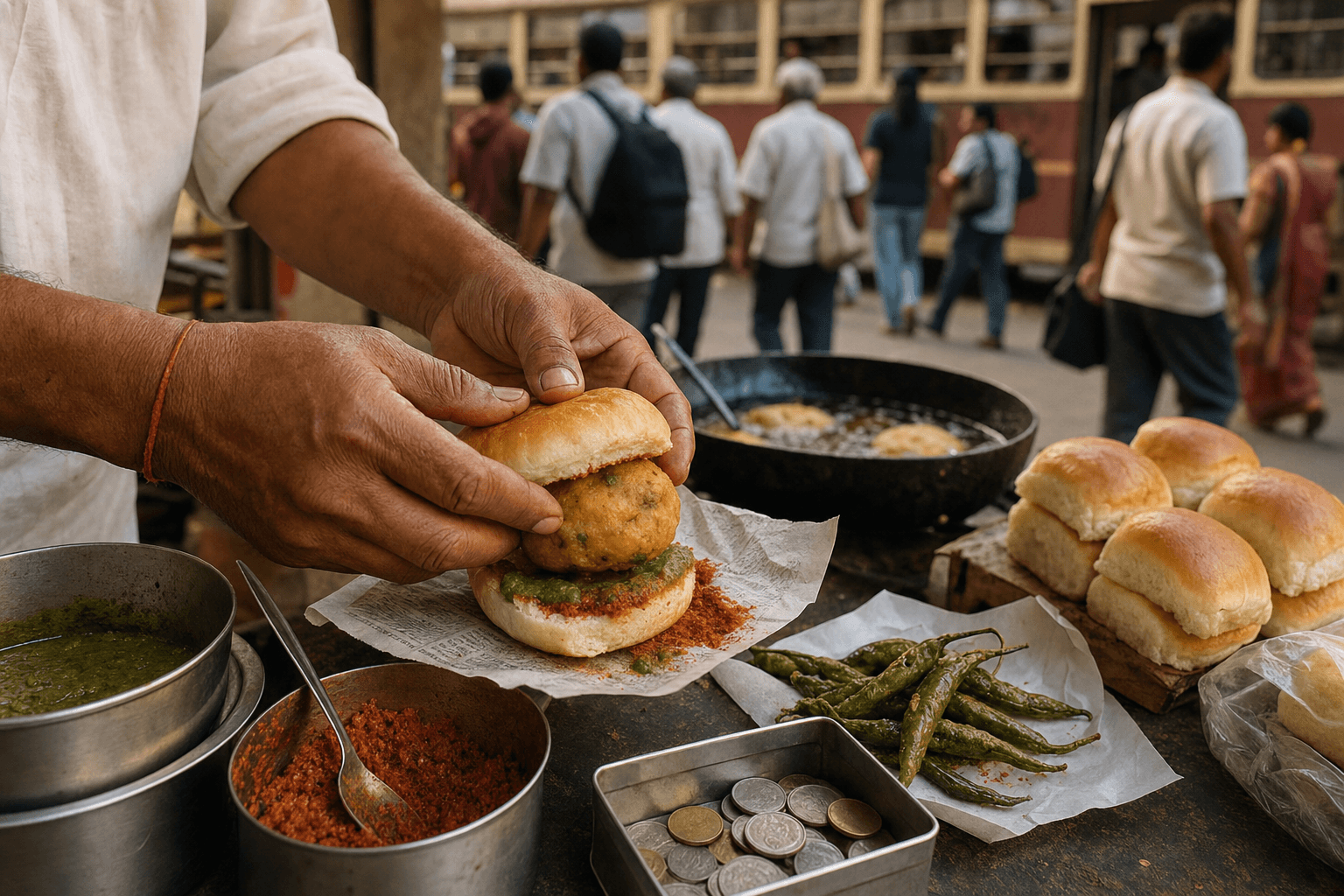
The corner near the bus stop. The man who was always there before you arrived and still there when you left. The newspaper cone, or the small paper square, already waiting near his hand.
The vada inside the pav - hot, slightly crisp on the outside, the potato filling soft and spiced, the green chutney that hit first, the dry garlic chutney that stayed.
He would press the pav once with his fingers.
Not gently.
Just enough.
Then a quick slap of chutney with the back of a spoon. One fried green chilli on the side if you asked. Coins dropped into a steel dabba without anyone counting too slowly.
Two rupees.
Maybe three by the mid-90s.
You didn't think about it.
You ate it standing up.
You ate it walking.
You ate it between things - between the bus and the office, between college and home, between one part of the day and the next.
It wasn't a meal you sat down for.
It was the city handing you something while you kept moving.
In the 1990s, Mumbai ran on vada pav the way other cities ran on nothing equivalent.
Not because it was special.
Because it was everywhere.
Because it cost almost nothing.
Because it was hot.
Because it never asked for your time.
The man at the corner knew his timing. The oil was right. The vada was never soggy, never too dry. The pav had exactly the right give - soft enough to hold the heat, firm enough not to fall apart in one hand while the other hand held a bag, or a handle, or nothing at all.
You didn't know his name.
He probably didn't know yours.
But he knew what you wanted.
And you knew what he would give you.
The transaction happened in seconds.
Then you were back in the city.
Moving again.
"It was the city handing you something while you kept moving."
That was vada pav.
That was also Mumbai.
The history came later.
Much later, the way these things always do.
Someone mentioned Ashok Vaidya.
1966.
A man with a cart and a practical problem: thousands of people moving through the city hungry, hurried, and short on money.
The Girangaon mills were still running. Dadar, Parel, Lalbaug, Lower Parel - the old mill belt had its own rhythm. Shift after shift. Men coming out tired. Men going in. Lunch had to be quick. Cheap. Portable.
Ashok Vaidya sold batata vada.
He sold bread.
The origin story most people tell is simple: at some point, he put one inside the other.
No test kitchen.
No investment.
No brand strategy.
A man at a cart, a crowd in motion, a solution that took ten seconds to assemble and twenty seconds to eat.
The mill workers bought it.
Then commuters bought it.
Then families bought it.
Then the whole neighbourhood bought it.
Then Mumbai could not remember a time before it.
The potato in the vada is not originally Indian.
That detail arrives like a small disruption once you know it.
Batata carried the memory of the Portuguese word.
The potato had crossed oceans before it entered Indian kitchens and became ordinary enough to stop sounding foreign.
The pav had traveled too.
Pao.
Bread.
Portuguese coastal influence, local bakers, Mumbai streets, soft white rolls that became inseparable from the city.
The Portuguese left.
The bread stayed.
So the most Mumbai food in existence was not pure in any simple way.
Two of its anchors came from elsewhere.
The potato.
The bread.
The chutney was local.
The heat was local.
The hand that assembled it was local.
The hurry was local.
Mumbai did the rest.
A city built by arrivals understands this without needing to say it.
People arrived.
Ingredients arrived.
Languages arrived.
Work arrived.
Hunger arrived.
The city did what it always does.
It put things together.
And after enough time, no one asked where they had come from.
That corner near the bus stop.
That man who was always there.
That two-rupee transaction that took less time than a sentence.
That was also a 400-year story.
You just didn't know it while you were eating.
After the 1982-83 textile strike, the old mill world began coming apart.
Not all at once.
That is not how cities change.
They change by making the old thing less possible each year.
Factories closed.
Workers were pushed out.
Land became worth more without the people who had given it meaning.
Parel and Lower Parel became something else entirely - offices, malls, towers, restaurants where a single meal could cost more than a week of old lunches.
But the vada pav cart stayed.
Not the same cart.
Not the same man.
But the same kind of corner.
The same quick assembly.
The same heat.
The same one-handed food for a city that still did not have time to sit down.
The city changed around it.
The vada pav adjusted without becoming something else.
That corner near the bus stop.
You don't remember the man's face clearly.
You remember the oil.
You remember the green chutney hitting first.
You remember the dry garlic dust on your thumb.
You remember the wrapper going soft from the heat.
You remember eating it between things, the city moving around you, not thinking about it at all.
That was the point.
The best food in a city like Mumbai is the food that doesn't ask you to think.
It just feeds you.
And sends you back.
Into the crowd.
Into the noise.
Into the next thing.
The city handing you something while you keep moving.
Historical note
Vada pav's most widely told origin story connects it to Ashok Vaidya's 1966 stall outside Dadar station, where commuters and workers became early patrons. Food historian Mohsina Mukadam, cited by NPR/NHPR, also notes the European introduction of potato to India and the Portuguese origin of pao, which became pav. Mumbai's mill-worker world and the 1982 textile strike are part of the history around the food's rise and spread.